The short answer
A meter that moves with all taps off means water is passing through it, though not always from a leak you can see. Close the main valve at the house: if the meter stops, the water is being used inside, in a toilet, water heater, softener, ice maker or a hidden pipe. If it keeps moving, check irrigation and pool lines, then the buried line before the valve. Work through the eight causes one at a time and you can usually name the culprit in about 15 minutes.
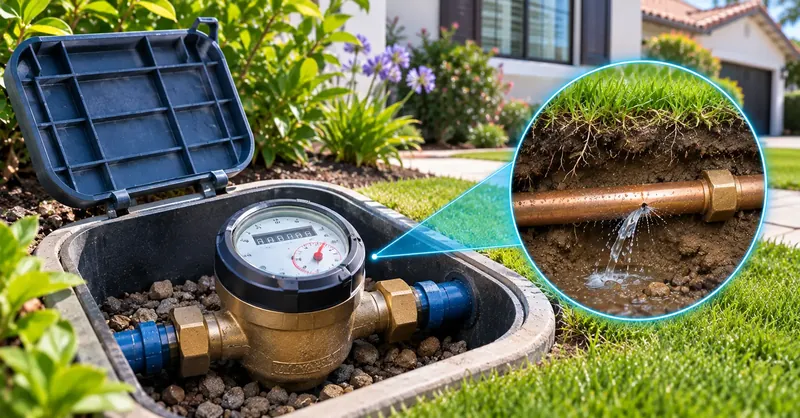
First, is the meter really moving?
You switched everything off, read the meter, and it is still going. You checked the toilets and found nothing. This is the most frustrating version of a leak hunt, and the answer is often something other than a burst pipe.
Start by checking what kind of movement you are seeing. On an analog meter, the small leak indicator spins even for a trickle, and the odometer digits only advance with real flow. A digital meter shows a flow rate, which should read zero when no water is being used. Some meters flutter slightly back and forth when pressure changes. Only an advance in the register digits counts, so photograph them and compare after a wait.
Then note the pattern. Steady, continuous movement suggests a leak or a valve stuck open. Movement in bursts every few minutes suggests something that refills or cycles. Movement at the same time each day suggests a scheduled device. Our home water leak test shows how to take clean readings, and the pattern you see here will help you read the causes below.
What are the eight most common reasons a meter moves?
1. A toilet that leaks or keeps refilling
A flapper that does not seal lets water trickle into the bowl, and the tank refills in short bursts to replace it. A stuck fill valve can run steadily. Add a few drops of food coloring to the tank without flushing, and look for color in the bowl after 10 to 15 minutes. Closing the toilet's own supply valve and watching the meter confirms it.
2. An ice maker, refrigerator line or filter
Ice makers fill in short cycles, and a loose or cracked supply line behind a refrigerator can leak for a long time before the floor shows it. A reverse osmosis system with a faulty valve can also drain continuously. Close the small valve feeding the appliance, which is often under the sink or behind the unit, and see whether the meter stops.
3. A water softener or filter in a cycle
Softeners regenerate on a schedule, often overnight, and use water when they do. That shows on the meter as bursts at fixed times. Check the controller's schedule. A softener that runs far too often, or never seems to stop, may have a failed valve, so try the bypass and watch the meter.
4. The water heater
Heating water makes it expand. In a system that cannot push that extra water back into the supply, pressure rises, and a relief valve may release small amounts. Fittings and tank seams can also drip. Look at the relief valve discharge pipe and the base of the tank for dampness, and listen for dripping. Closing the cold supply to the heater for a few minutes shows whether it is involved. Whether your home needs an expansion tank is a question for a plumber.
5. Irrigation or a pool auto-fill
A stuck sprinkler valve, a leaking backflow device or a cracked drip line can flow steadily, and a pool auto-fill that sticks open adds water all day. These lines are often connected ahead of the main house valve, so closing the house valve may not stop them. See our guides to irrigation leak detection and pool leak detection.
6. A leak in the buried line
If the meter keeps moving after you close the main valve at the house, and the irrigation and pool are off, water is escaping between the meter and the valve. A wet or unusually green patch of ground and weak pressure are the usual companions. That is the territory of water line leak detection.
7. A leak inside the house that you cannot see
If the meter stops when the main valve closes but none of the suspects above is responsible, the water is escaping from a pipe inside a wall, ceiling or slab. Warm floor patches, hissing sounds, stains or a musty smell point that way. Read about hidden leak detection and slab leak detection.
8. The meter or the billing, not the plumbing
It is rare, but a meter can register incorrectly, and a billing period or estimate can make usage look worse than it was. Only consider this after the earlier causes have been ruled out. The section on utilities below explains what to ask.
How do you find the culprit in about 15 minutes?
The method is to switch off one suspect at a time and watch the meter after each. Give each step a few minutes, because a slow flow can take a moment to register.
- Stop everything you control.Close taps, make sure the dishwasher and washing machine are idle, and switch off the irrigation controller. Take a photo of the meter.
- Close the irrigation and pool supply valves.If the meter stops, one of those systems was the cause.
- Close the main valve at the house.If the meter stops, the water is being used on the house side. If it keeps moving, the water is escaping before the valve, on the buried line, or the meter is at fault.
- Reopen the main valve slowly, then isolate one thing at a time.Close the water heater's cold supply, the softener (use its bypass), the ice maker valve, and each toilet's supply valve in turn. Watch the meter after each.
- If nothing stops it, the leak is in the pipes.A leak inside a wall, ceiling or slab is the remaining suspect, and a provider can locate it without guesswork.
Use this table to read the results as you go.
| What you closed | If the meter stops | It points to |
|---|---|---|
| Irrigation and pool valves | Yes | The sprinkler system, a drip line or the pool auto-fill. |
| Main valve at the house | Yes | Water use inside the house. Keep isolating. |
| Main valve at the house | No | A leak on the buried line before the valve, or a meter issue. |
| Water heater cold supply | Yes | Heater leak, relief valve or expansion. |
| Softener bypass | Yes | A softener or filter cycle or valve fault. |
| One toilet's supply valve | Yes | That toilet's flapper or fill valve. |
| Ice maker or fridge valve | Yes | A leaking or constantly filling appliance line. |
Warning: be careful with the water heater
Keep the heater's cold supply closed for only a few minutes, and do not open hot taps while it is closed. Reopen valves slowly so you do not cause a pressure surge. If you are not sure how to isolate an appliance safely, leave it for a plumber.
How do you tell a trickle from a real problem?
Size matters. A leak that moves the meter a little once an hour is very different from one that moves it continuously. Our meter leak calculator turns two readings into gallons per day, which is the number you want when you talk to a provider or your utility. As a reference, one cubic foot is about 7.5 gallons, and one CCF, or 100 cubic feet, is about 748 gallons.
| Pattern on the meter | What it usually means |
|---|---|
| Steady and continuous | A stuck valve, a failed fill valve or a leak in a pipe. |
| Short bursts every few minutes | A toilet refilling, water heater expansion or an ice maker cycle. |
| Bursts at the same time each day | A softener, an irrigation controller, a pool fill or a delayed appliance. |
| A single movement, then nothing | Water was used, or a one-off cycle ran. |
When could it be the meter or the bill and not a leak?
If you have been through every step, the main valve test still shows movement, and a provider has found nothing on the buried line, ask your water utility to review the meter. Keep a short record: dates and times, photos of the register, what you switched off and the result. Ask whether they can test the meter, whether they can show usage by day or hour, and what their policy is on leak adjustments. Practices and fees differ between utilities, so ask before you assume.
A high bill alone does not prove a faulty meter. Our guide to high water bill leaks explains how to compare billing periods and separate real changes in use from a leak.
When should you call for help?
Call if the meter keeps moving after you have isolated everything you can, if the main valve test points to the buried line, or if you notice warm floors, wet ground, stains or hissing. Share your readings and the results of each step. That history lets a provider skip the basics, and if you want to find the source of a leak without opening floors or yards, a local leak detection provider can take it from there.
Meter moving but no leak found: FAQs
Can a water meter move when there is no leak at all?
Yes. A meter records water passing through it, not leaks. An ice maker filling, a softener regenerating, an irrigation timer, a delayed dishwasher cycle or a toilet refilling will all move it. That is why the first job is to switch off everything you control and then work through the suspects one at a time.
Is a tiny flutter on the meter a leak?
Only if the register actually advances. Some meters flutter slightly back and forth when pressure changes, with no net change in the reading. Photograph the digits, wait, and compare. If the numbers did not go up, you are not looking at a leak.
Why does my meter only seem to move at night?
Scheduled devices usually run overnight: water softeners regenerate, irrigation controllers start, pool fill valves open and delayed-start appliances run. A real leak runs around the clock, but night is simply when you notice it, because the house is otherwise quiet.
How can I tell whether the meter itself is faulty?
Rule out the suspects first, including irrigation and pool lines. Then close the main valve at the house and watch. If it still moves and a provider has found no leak on the buried line, ask your water utility to test the meter. A faulty meter is possible but much less common than a leak.
Will my water utility help if the leak is on my side of the meter?
Policies vary. In general, the utility looks after its side of the meter and the property owner looks after the pipe from the meter onward. Some utilities offer leak adjustments, payment plans or usage alerts, so it is worth asking what yours provides.
Keep reading
If the checks point to a specific kind of leak, these guides explain the signs, causes and what a provider does on site.